Call for partnership approach to support City of Melton’s future
Published on 02 February 2026
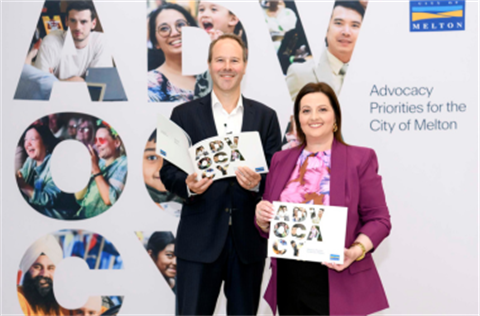
Melton City Council has announced its latest advocacy priorities calling on a whole-of-government investment approach to meet the needs of its rapidly growing community.
The priorities were unveiled by Mayor Cr Lara Carli at an event last Friday in Fraser Rise, one of the fastest‑growing areas in Australia, and featured a keynote address by Dr Jonathan Spear, CEO of Infrastructure Victoria.
With the City’s population set to double over the next 20 years, the advocacy priorities identify the community’s current and future needs and outline how the Australian and Victorian governments could partner with Council to deliver them.
The advocacy priorities are aligned to six key themes: Employment and Investment Attraction, Transport, Education and Skills, Health and Wellbeing, Environment, and Financial Sustainability.
Each theme outlines the investment needed to create opportunity, support liveability, attract investment, and sustainably manage a rapidly growing city.
Key priorities include:
- fast‑tracking the development of employment precincts to help create 100,000 jobs by 2050
- improving public transport, including delivering the electrification of the Melton rail line by 2030 and building three new train stations
- major upgrades to key arterial roads across the city
- boosting business attraction initiatives to support more local jobs
- more local schools, expanded TAFE options, and establishing a university to create pathways into future careers, and
- improved access to local health, wellbeing, and education services.
Council acknowledges the significant investments made to date by the Australian and Victorian governments, including the new Melton Hospital, Melton TAFE, new schools, level crossing removals, and the $1 billion upgrade committed for the Western Highway.
Council is also making major contributions towards the City’s infrastructure needs, by delivering projects such as the Community Services Building in Cobblebank, the Aquatic and Leisure Centre in Fraser Rise, new road connections, community facilities and active open spaces.
Find out more about the City of Melton’s Advocacy Priorities.
Quotes attributable to City of Melton Mayor Cr Lara Carli:
“Council’s advocacy priorities outline the investment that we are seeking in partnership with the Australian and Victorian governments, to support the City’s growth.
“In recent years, it’s been encouraging to see that many of the challenges we face are already being met. We’ve welcomed significant investment from both the Australian and Victorian governments on some truly transformational projects, including the Melton Hospital, upgrades to the Melton rail line, investment in education and commitments to upgrade the Western Highway.
“Our advocacy priorities have been informed by listening to our community and understanding what matters to them most. Our community has been clear about the future they want: one that is prosperous, educated, connected, healthy, safe and sustainable.
“That’s why we why are advocating for further investment in major roads, electrification of the Melton rail line, new train stations, and fast-tracking of employment precincts.
“We know this will require a long-term commitment and genuine partnership across all levels of government, and we look forward to continuing to work together to achieve this vision.”
Quotes attributable to Dr Jonathan Spear, CEO Infrastructure Victoria
“Infrastructure Victoria’s recommendations in our 30-year strategy have strong alignment with the priorities of Melton City Council.
“Investment in high quality bus services and the electrification of the Melton rail line along with new stations in Mt. Atkinson and Thornhill Park will deliver much-needed access to quality public transport, unlock the regional rail network, and deliver enormous productivity to the economy and boost jobs.
“Growth areas like the City of Melton need early planning and investment in schools, kindergartens, community health services, libraries, aquatic facilities and open spaces, with a shared investment approach across all levels of government.”